
Conrad Weiser Student Wins Science Fair Honors for Community Cat Research
Published On: 3/16/2026
Last Updated On: 3/16/2026
By Callie, Seymour, Yebba, and Mama and our Hooman Ashley!
FREE CAT HAIR HACKS
⬇️
FREE CAT HAIR HACKS ⬇️
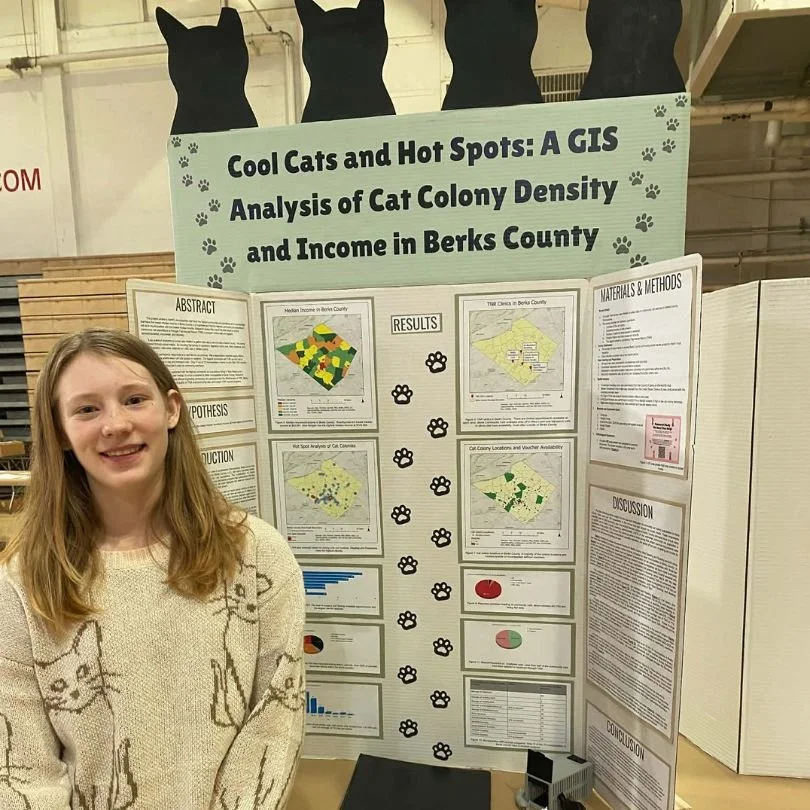
Conrad Weiser Middle School Student Rebecca standing with her winning project
Did you know that thousands of cats are living outdoors in Berks County?
For Conrad Weiser student Rebecca Lee, that question became the focus of months of independent research and community involvement — and recently earned her recognition at the Reading–Berks Science & Engineering Fair.
Rebecca’s interest in community cats began last year through a series of experiences that helped her notice how many cats live outdoors in local neighborhoods.
During a visit to her grandparents’ farm last October, Rebecca visited a nearby dairy farm where she saw barn cats and learned that a friend later adopted one of the kittens. Around the same time, she also began noticing outdoor cats while walking with her family in her development.
Earlier in the summer, a friend’s cat named Saffron went missing during a storm. While searching for the cat using trail cameras, Rebecca’s friend began capturing images of outdoor cat colonies, which further sparked Rebecca’s curiosity.
Throughout the summer and fall, Rebecca also became involved in helping rescue cats in need. In August, she helped rescue two small kittens named Shrimp and Salmon from a porch in town. In September, she helped rescue a stray barn cat who needed veterinary care. That cat, now named Apple, currently weighs four pounds and is continuing to recover.
These experiences motivated Rebecca to begin researching the issue more deeply.
Over the following months, she spent time visiting the community library, reviewing sources, and studying how outdoor cat populations are managed. Rebecca also learned about Trap-Neuter-Return (TNR) programs — a humane approach that involves trapping outdoor cats, spaying or neutering them, vaccinating them, and returning them to their outdoor homes.
Through her research, Rebecca discovered that counting community cats can be difficult, but estimates suggest there may be as many as 60,000 stray or community cats in Berks County.
Rebecca also learned about some of the challenges these cats face. According to her research, feral cats typically live about half as long as indoor housecats, and outdoor colonies can grow quickly if cats are not spayed or neutered.
She also explored how people help outdoor cats in their communities. Some common ways include providing food, arranging veterinary care, fostering cats, volunteering at shelters, and supporting TNR programs.
Rebecca turned her research into a science fair project titled:
“Hot Spots and Cool Cats: A GIS Analysis of Cat Colony Density and Income in Berks County.”
The project used geographic analysis to examine patterns related to cat colonies in the county.
Her work was recently presented at the Reading–Berks Science & Engineering Fair, where Rebecca earned 2nd place and received a cash prize.
She was also awarded a certificate from the Association for Women Geoscientists and received the Frank D. Herron Memorial Award, which recognizes the most unusual project presented at the fair.
Rebecca says she hopes her project helps people better understand community cats and the role that Trap-Neuter-Return programs can play in helping manage outdoor cat populations humanely.
She also hopes the research helps raise awareness of the challenges communities face when addressing stray cat populations.
For Rebecca, the project has been both an academic experience and a way to contribute to her community.
“I’m proud that I’m able to help spread awareness of cat colonies and how the TNR process works and is effective,” she said.
Full Interview: Rebecca & Family on Stray Community Cats
The following responses are shared with permission and preserved in full to honor the heart and research behind this project.
Student: Rebecca Lee
1. What made you interested in learning about community cats and cat colonies?
In October, on a visit to my grandparent’s farm we visited a local dairy farm. We saw their barn cats with a friend who later adopted one of the kittens. That weekend made me interested in learning about community cats.
2. When did you first notice cats living outdoors in your area?
I first noticed cats living outdoors in my area this past summer. When my family went for walks in my development you could see a few cats outside wandering around the neighborhood. Also, In July, my friend's cat Saffron went missing during a big storm. She put up trail cams to look for her cat and she kept showing me all the cat colonies she was seeing outside. In August, I helped rescue two small kittens (Shrimp and Salmon) off a porch in town. In September, I helped a friend rescue a stray barn cat who needed vet care. Apple now weighs a total of 4 pounds. These experiences helped me really notice the cats living outdoors.
3. What surprised you the most while working on this project
How many cats are in Berks County. We only received responses for around 1,600 cats. According to one of my sources, there are about 60,000 cats in Berks County. That’s only about two percent of the cats. Also, on average feral cats live half as long as housecats. If you see them, it’s important to try to take them in, but if you can’t, take them to a shelter.
4. What did you learn about how people help outdoor cats?
I learned that people help outdoor cats by providing regular food, getting them vet care, fostering the cats, volunteering at shelters and doing Trap-Neuter-Return (TNR).
5. Was there anything that made you feel worried or sad while researching this topic?
I was sad to learn how many stray cats are living in Berks County. It’s very hard to count, but sources estimate there are at least 60,000 stay cats in Berks County alone. If a cat doesn’t get what they need they often have lots of kittens which can hurt their bodies. Also, they can starve or get eaten by other animals. It also worries me how fast diseases can spread within the cat colonies and can even spread to other animals or humans.
6. What do you think people misunderstand most about stray or community cats?
Many people believe that stray or community cats are a problem to the human population. However, most feral cats are not aggressive and are used to living outside.
Many people don’t understand that TNR DOES work. Some of our responses to the survey said that euthanasia is a better solution, and they believe TNR isn’t effective. However, the TNR process helps because once 75% of the cats in a colony are spayed or neutered, the population does not keep growing. Over time, this reduces the number of stray cats in a safe and humane way.
7. What do you hope people learn from your project?
Through my project, I hope others learn that TNR helps cat colonies. I found there are many challenges to TNR (cost, time and education on TNR). My hope is communities are able to. better address these challenges to help cat colonies.
8. If you could tell adults one thing about helping cats in the community, what would it be?
If you find cats outside you should first feed the cat to gain their trust. Then, they should set out a humane trap overnight. Once the cat is trapped, put a blanket over them to calm them down and take them to a TNR clinic. When the vet has finished caring for the cat, you can do one of three things: Keep them, take them to a shelter or nicely release them back outside.
9. What part of this project are you most proud of?
I'm proud that I’m able to help spread awareness of cat colonies and how the TNR process works and is effective. I’m also proud of the work that went into it and how supportive my teachers are. I hope this project benefits cats and TNR in the future.
10. Do you have any pets? If so, what kind of animals are they and what are their names?
What do you love most about your pets?
Yes, I have a cat named Tuna who was rescued and fostered by a family in Berks County. My favorite thing about him is that he's calm but also loves to be played with. I used to have a dog named Cody; I liked how friendly he was to everyone he met.
Mom — Katie Lee
1. What was your first reaction when your child became interested in this project?
Amazed! This project has been completed out-of-school, independent of her school curriculum. I have enjoyed watching Rebecca’s interest in her community, current events, and active research over the past months.
2. How did you support her during the research process?
At Rebecca’s lead, we read scholarly articles and explored community websites to thoroughly research the concerns feral cat communities face. As a family, we’ve hung posters in local pet stores and spent many nights learning and discussing the research. Rebecca has spent many night and weekend hours working on this project — researching, mapping out pet stores and vet offices to visit, entering geo-coordinates, and reviewing her data. I know that Rebecca is very proud of the time she spent on this process and her results.
3. Did this project spark any family conversations about animals or community care?
Absolutely! My daughters spend many weekends helping on a local farm, where they help take care of poultry and a horse. Through this project, they have gained firsthand experiences with the TNR process and visited feral cat communities. It’s been encouraging to talk about our responsibilities to animals and our community!
4. What did you learn alongside her that you didn’t know before?
I was amazed to learn how fast a cat community can grow.
5. How did you see her confidence or curiosity grow during this experience?
Rebecca has personally grown so much during this experience! She’s completed her first hours volunteering, called businesses on her own, and asked for permission to hang posters. Rebecca’s growth in confidence will certainly be an asset to herself, and those around her.
6. Why was it important to you to support her participation in this project?
This project encouraged Rebecca to independently research and connected her to the community. By supporting Rebecca’s participation in this project, we’ve been able to learn together — with Rebecca often explaining what she’s learned to us.
7. What would you want other families to know about encouraging kids to explore their interests?
This longevity and extensive nature of this project has truly connected our family. From the summer through the winter, we’ve been introduced to cat communities, spent nights of research and hanging posters, and hours of data gathering and analyzing. This project has been the catalyst for academic and personal growth for Rebecca — it’s definitely seen many proud parent moments!
Dad — Mike Lee
1. What was your first reaction when your child became interested in this project?
I was really happy she chose it. It’s not just about cats, it’s about helping the community, and I thought it was a great thing for her to care about. Honestly, we’ve never owned a cat before our current one, Tuna. Since we adopted him a little over a year ago, I’ve noticed she’s taken a big interest in cats and even started coming up with hypothetical science fair projects for fun before she learned about and participated in this one.
2. How did you support her during the research process?
She’s been very independent and self-motivated with this project, which I’m really proud of. My role was mostly encouraging her and helping remove small obstacles — checking in to see if she needed anything and sharing her survey with some TNR groups online to get more responses.
3. Did this project spark any family conversations about animals or community care?
Not in a big formal way, but it did lead to some casual conversations about cats, overpopulation, and how TNR helps communities — especially as she got deeper into the project.
4. What did you learn alongside her that you didn’t know before?
I didn’t realize how big of an impact TNR programs have on both cat populations and local communities or how effective they are. It was surprising to see how much of an issue this is right here in Berks County and how much difference even small local efforts can make.
5. How did you see her confidence or curiosity grow during this experience?
I could see her get more confident as she learned more and got deeper into the project. She even volunteered at the Berks Community Cat Center and came home really excited about it, which was great to see. The volunteers said they were really impressed with how much care and attention she put into helping the cats and that she also took time to learn and gather information for her project.
6. Why was it important to you to support her participation in this project?
I supported her because she picked a project that matters to her, and I wanted to be there to encourage her further and provide help when she needed it.
7. What would you want other families to know about encouraging kids to explore their interests?
Encourage their curiosity and give them space to explore. Even if something seems small or unconventional, allowing them to take ownership helps them grow and get genuinely excited about learning.